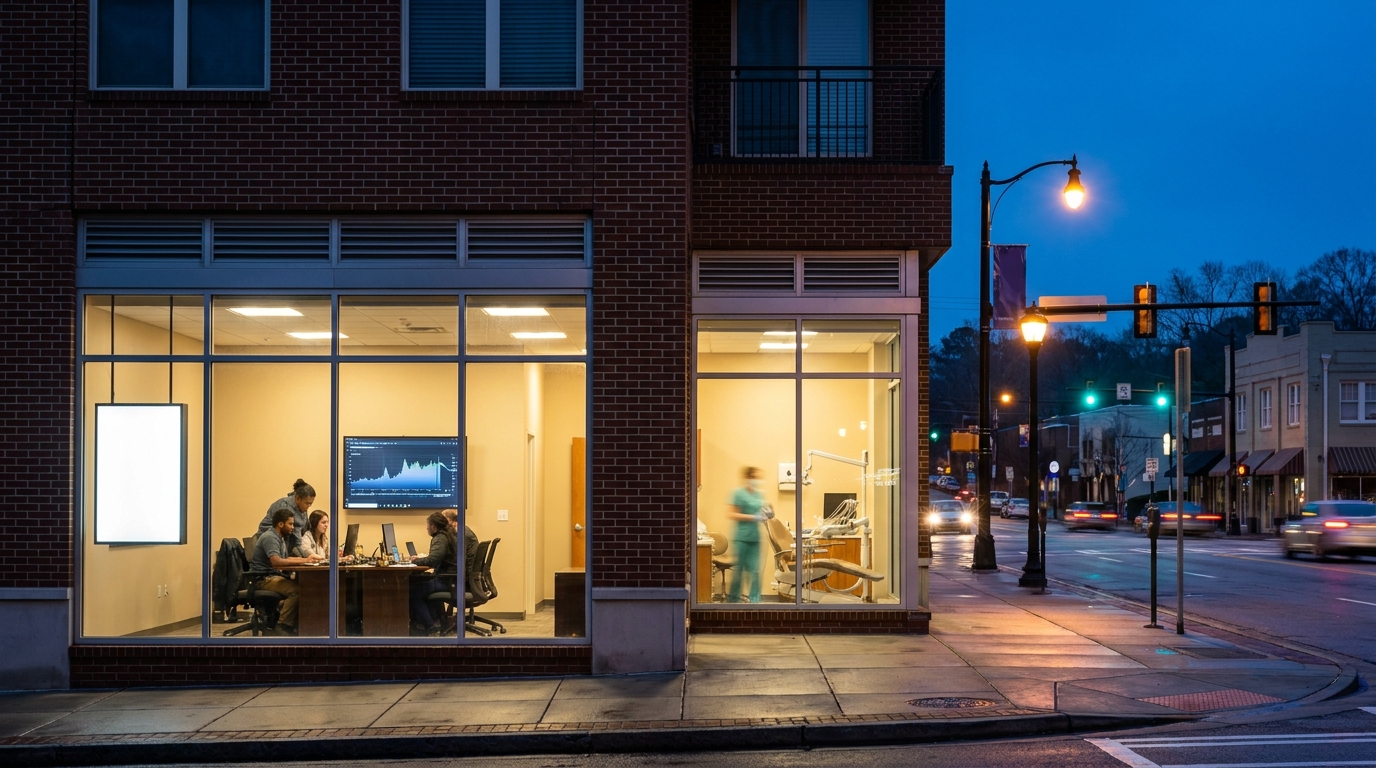
Dental Patient Acquisition Funnel in Virginia Beach, VA
Build a repeatable new patient pipeline for your Virginia Beach dental practice with a systems-based acquisition funnel that runs without constant effort.

If your Virginia Beach dental practice is stuck relying on word-of-mouth, sporadic referrals, and whichever ad rep called last, you don't have a marketing problem. You have a systems problem.
A patient-generating system is infrastructure — not effort. It's a repeatable pipeline that attracts, qualifies, books, and retains new patients on autopilot, so growth stops depending on your front desk remembering to follow up with a lead from three weeks ago. Below is how to build one, specifically for the Virginia Beach market.
What Is a Patient-Generating System?
A patient-generating system is a connected set of assets and automations that consistently converts strangers into booked new patients. It replaces one-off tactics — a Groupon here, a Facebook boost there — with a durable pipeline.
Think of it in four layers: attention, capture, conversion, retention. Every layer feeds the next. If any one breaks, the whole system stalls — which is usually why practices plateau despite spending more on ads.
The old model is effort-based: work harder, buy more ads, hope the phone rings. The modern model is systems-based: build infrastructure once, refine it monthly, let it compound. That's the mental shift.
Step 1: Anchor the System to a Real Local Positioning
Before you touch an ad platform, define who you're for. "General dentistry in Virginia Beach" is not positioning. It's wallpaper.
Virginia Beach has distinct patient pockets — young military families around the Oceana and Dam Neck bases, established professionals in Great Neck and Alanton, retirees in Sandbridge and Kempsville, and a heavy summer tourist flow along the Oceanfront. Each pocket has different insurance patterns, different urgency triggers, and different price sensitivity.
Pick two you want more of. Build the messaging around them. A dental patient acquisition funnel in Virginia Beach that speaks specifically to TRICARE-covered military families will outperform a generic "quality dentistry" campaign every time — because relevance is the cheapest form of conversion.
Step 2: Build the Attention Layer
The attention layer is how strangers first encounter you. In 2026, that's three channels, in this order of ROI for most Virginia Beach practices:
- Google (Search + Maps + LSA): High-intent. Someone searching "emergency dentist Hilltop" is ready to book today.
- Meta (Facebook + Instagram): Low-intent, high-volume. Ideal for cosmetic, Invisalign, and implant offers where you're creating demand, not capturing it.
- Organic + community authority: Google Business Profile posts, review velocity, local content, and visible involvement in things like the Neptune Festival or Something in the Water weekend.
Most practices dabble in all three and dominate none. Pick the two that match your target patient and go deep. Depth beats breadth in every local market, and Virginia Beach is no exception — the competitive set here is real, especially along Virginia Beach Boulevard and the Town Center corridor.
Step 3: Build the Capture Layer
Attention without capture is a leak. Every click, call, and DM needs a defined path to a booked appointment.
At minimum, your capture layer needs:
- A landing page per offer — not your homepage. One page, one offer, one call to action.
- A short intake form (name, phone, reason for visit, insurance) — fewer fields, higher conversion.
- Click-to-call on mobile, because more than half of dental searches in Virginia Beach happen on a phone.
- An after-hours capture path — chat, SMS, or a callback form — because dental emergencies don't respect office hours, especially during summer tourist season when demand spikes.
If your website is a general brochure with a "Contact Us" page, you don't have a capture layer. You have a business card online.
Step 4: Automate the Conversion Layer
This is where most Virginia Beach practices bleed money. A lead comes in, sits in an inbox, gets called 26 hours later, and never books. Automated patient generation for dentists solves this with three non-negotiables:
- Speed-to-lead under 5 minutes. Automated SMS the moment a form is submitted. Not "we'll get back to you." A real message that offers two appointment windows.
- Multi-touch follow-up over 14 days. If they don't book on the first contact, a sequence of texts and emails that stays helpful, not pushy. Most bookings happen on touch 3-7, not touch 1.
- Missed-call text-back. Every missed call triggers an instant SMS. This single automation recovers a meaningful share of the leads your front desk was previously losing.
None of this requires a bigger team. It requires the right stack wired correctly.
Step 5: Build the Retention and Referral Layer
A new patient pipeline for a dental practice isn't complete until existing patients feed it. Retention and referral are the compounding part of the system — the reason a practice with a working funnel gets cheaper to grow every year.
Three automations that matter:
- Reactivation campaigns targeting patients who haven't been seen in 9+ months. Usually the highest-ROI email you'll ever send.
- Review requests triggered after every completed appointment. Google review velocity is the single strongest ranking signal for local dental search in Virginia Beach.
- Referral prompts after positive reviews. If they gave you five stars, ask them who else they'd recommend you to.
Step 6: Measure the System, Not the Tactics
Most dentists measure ad spend. That's the wrong number. Measure the system:
- Cost per booked new patient (not cost per lead)
- Show rate (booked vs. actually walked in)
- New patient lifetime value by source
- Speed-to-lead average across all channels
- Reactivation rate on 9+ month lapsed patients
When you know these five numbers, you stop guessing whether marketing is working. You know exactly which layer to fix.
How Long Does It Take to Build?
A functional dental marketing funnel build in Virginia Beach takes roughly 30-60 days to stand up and 90-120 days to fully optimize. The attention layer produces the first bookings inside week two or three. The retention automations compound from month four onward. Anyone promising booked chairs in week one is selling ads, not a system.
Doing It In-House vs. Bringing in a Specialist
You can build this yourself. It requires a competent marketer, a paid ads specialist, a copywriter, an automation builder, and a project manager to keep them synced. Most practices don't have that bench, and hiring it costs more than outsourcing it.
The alternative is working with a firm that has already built this system for dental practices and simply installs it in yours. That's the model we use at All In Practice Growth — we treat the funnel as infrastructure the practice owns, not a monthly ad retainer that disappears when you stop paying.
Frequently Asked Questions
How much should a Virginia Beach dental practice spend on patient acquisition?
A working benchmark is 5-8% of collections for established practices and 10-12% for practices in a growth phase. What matters more than the percentage is the cost per booked new patient relative to their lifetime value — if a patient is worth $1,800 over their tenure and you're acquiring them for $180, spend more.
Do I need a new website to build a patient-generating funnel?
Not always. You need functional landing pages, fast load times, and clean mobile behavior. A full rebuild is only necessary if the current site is slow, unindexed, or structurally broken. Many practices launch the funnel on dedicated landing pages first and rebuild the main site later.
What's the biggest mistake dentists make with patient acquisition?
Buying ads before building capture and conversion. Traffic without a system just exposes the leaks — you spend more, book roughly the same, and blame the ad platform. Fix the pipeline first, then feed it.
How is this different from just running Google Ads?
Google Ads is one channel inside the attention layer. A patient-generating system connects attention to capture, conversion, retention, and measurement. Ads produce leads; systems produce booked, retained, high-value patients.
The Bottom Line
Growth stops being random when you stop treating marketing as a series of tactics and start treating it as infrastructure. A dental patient acquisition funnel in Virginia Beach that runs on speed-to-lead automations, disciplined follow-up, and measured retention will outperform any single-channel push, no matter how big the ad budget.
Practice owners in Virginia Beach who want this system built, installed, and measured rather than assembled piece by piece can reach All In Practice Growth at https://www.allinpracticegrowth.com to discuss what a build looks like for their practice.